
Everything the capture bar understands
Every format the capture bar reads in six languages - amounts, sums, currencies, dates, categories, wallets, income, refunds, transfers, estimates and trips.
On this page
The capture bar reads one line in English, German, Spanish, French, Macedonian or Hindi. Word order does not matter, and Tavala re-reads the line after every keystroke, so the chips above the field always show what will be saved. This page lists the rules. For the steps, see Add an expense in one line.
How a line is read
- The words Tavala uses are taken out of the note: the amount, a currency symbol, code or word, a date
phrase, a wallet word, an estimate word,
~and a leading+. Everything else stays as the note, in the order and the case you typed it. - Words that pick a category, income, a refund or a trip stay in the note, because they are usually
the title.
coffee 4.80saves with the notecoffee. - Letters are compared without case and without accents, so
cafeandCaféare the same word. - Until the line has an amount, the bar shows your suggestions or says "Add an amount to save - like "3.80 coffee"", and the round button opens the full form with your words in it.
- When the line can be read more than one way (a currency several countries share, a transfer, a day that has not come yet, two amounts), the bar marks the chip with a question mark and does not save from the bar. See when the bar asks first.
- Autocorrect and word suggestions are off in the field.
Languages
English, German, Spanish, French, Macedonian (in Cyrillic and in Latin letters) and Hindi (in Devanagari and romanised) are read on any phone, whatever its language, and you can mix them in one line. A few short forms are read only when your phone is set to their language, because they are ordinary words in another one:
- Two- and three-letter weekdays such as
sat,Fr,vie,venandпет, unless they end with a full stop (sat.) or follow the language's "on" or "last" word. - The German estimate word
soand the Spanishcomo. - Numbers spelled in Latin letters in Macedonian (
sto dvaeset) and in romanised Hindi (do sau).
Amounts
| You type | Tavala reads |
|---|---|
3.80 or 3,80 | 3.80 (a point or a comma) |
250 | 250 |
1.500 or 1,500 | 1,500: one separator before exactly three digits is a thousands separator |
1.5 or 1,50 | 1.50: any other single separator is the decimal |
1.299,50 or 1,299.50 | 1,299.50: when both appear, the last one is the decimal |
1.250.000, 1,50,000, 1'234.56, 1 234,56 | 1,250,000, 150,000, 1,234.56 and 1,234.56 |
12 50, 12€50 | 12.50 |
5.-, 12,-, 200/- | 5, 12 and 200 |
.50 | 0.50 |
1.5k, 2K | 1,500 and 2,000 (k means thousand) |
2 lakh, 1.5 lakh, 1 crore | 200,000, 150,000 and 10,000,000 |
-12 lunch | 12.00: a leading minus is dropped, the entry is an expense |
1,2,3 or 12. | no amount |
0.001stays one thousandth, and so do currencies with three or more decimal places:1.500 BHDis one and a half dinar.- Devanagari digits (
२००) are read as digits.
Several numbers in one line
- The amount is the first number with a currency, else the first with a decimal part, else the first.
- A count of 1 to 20 before a word gives way to a larger price after it:
2 coffees 7.60is 7.60 and3 beers 12is 12, with the count kept in the note.20 lunch 5 tipstays 20. - A count joined to a price by
x,×,@or a word such as "at" is multiplied:3x 4,20 beeris 12.60 and2 pints @ 5.80is 11.60. - A number that belongs to a date phrase is never the amount:
taxi 3 days agohas no amount, and2 days ago 15 taxiis 15.
Sums and other operators
Join two or more amounts with an operator to calculate in the bar. The chip shows the result; the field keeps what you typed.
| Operator | Typed as |
|---|---|
| Add | + |
| Subtract | - |
| Multiply | *, x, X or × |
| Divide | / or ÷ |
- Spaces. A calculation can be one token (
lunch 12+8), and a plus or minus with spaces around it between two figures counts too:lunch 12 + 8is 20.00 and89,90 - 10 schuheis 79.90. A dash that is not between two figures is punctuation:coffee - 4.80is 4.80. - Precedence. Multiplying and dividing come before adding and subtracting, and each group runs
left to right:
2+3x4is 14 and20-4/2is 18. - Rounding. The whole calculation is done exactly and rounded half up once, at the end, to the
currency's decimal places:
40/3is 13.33, and1000/3 JPYis 333 because yen have no decimals. - Each part is an amount. It can use
kor a decimal comma:1.5k+2is 1,502.00 and1,5+2is 3.50. - One currency for the whole token. Put the symbol or code before or after it:
€12+8,12+8 EUR. A symbol in the middle (12+€8) gives no amount. - The result must be above zero.
5-5,12-20and5/0give no amount from that token, and their text stays in the note. A later plain amount still wins:5/0 7 lunchis 7.
Spoken lines
Dictation from your keyboard's microphone types number words, and the bar reads them like digits in
all six languages: twelve fifty lunch yesterday, zweitausendfünfhundert, dos mil quinientos,
quatre-vingt-dix-neuf, дваесет и пет илјади, दो सौ.
- Two numbers below 100 side by side are units and cents: "twelve fifty" is 12.50, "nine ninety nine" 9.99, never 1,250.
- A point word is the decimal point ("twelve point five", "zwölf komma fünfzig"), and so is a currency word between the two numbers ("zwei euro fünfzig" is €2.50).
- When you correct yourself, the last figure counts: "fifteen for parking no wait eighteen" is 18.
- A lone small number word before a noun is a count, not the amount:
one coffee 3is 3.00 with the note "one coffee". - Fillers such as "um" stay in the note and do not change the reading.
Currencies
If you type no currency, the entry uses the currency of the wallet in the wallet chip.
By symbol. Put a symbol before or after the number, or as its own word: €12.50, 12.50€,
€ 12.50, 250ден. Tavala knows the symbol of most currencies on its
supported list, such as €, £, ¥, ₹, ₽, ₺, zł,
R$ and ден.
By code. Type the three-letter code attached or as its own word: 250mkd, eur40, 250 MKD,
mkd 250. Coins work the same way: 0.01 BTC.
By word. A currency word next to the amount, in the six languages: 12 euros, 20 quid,
15 dollars, 20 dollars canadiens, 12 livres, 500 лева, 250 денари, 200 रुपये, Rs. 200,
2000den. A full currency word directly before the line's only number counts the same way:
euros 12 café is €12.00 and dollars 20 tip is 20.00 US dollars. The name of one of your wallets in that
place stays the wallet (cash 20 coffee is €20.00 from Cash), and un livre 12 is still a book for
12.
Which codes need capitals. Many codes are also ordinary words (pen, all, cup, bob), so a
code is read in any case only for:
- the 12 first currencies of the app (USD, EUR, GBP, MKD, JPY, CHF, CAD, AUD, PLN, DKK, NOK and SEK), the currencies of your spending wallets, your main currency and any currency already used in your wallets, entries or bills;
- codes that are no ordinary word, such as
mxnorczk.
Every other code and coin on the supported list is read in capitals only. So 12 PEN is Peruvian sol,
while 12 pen is a pen: 12 in your wallet's currency, with the note pen. A code that is not on the
list (12 XYZ coffee) stays in the note.
Symbols and words that several currencies share. The $ and "dollars" belong to about 30
currencies, kr and "kronen" to the Danish, Norwegian, Swedish, Czech and Icelandic crowns, "pesos" to
eight. Tavala picks the first of these that fits:
- The wallet's currency, if it uses the symbol or word.
- Your main currency, if it does.
- The only currency that uses it.
- The symbol's or word's own currency:
$and "dollars" are the US dollar,£the pound sterling,¥the yen. - The answer you gave before on this device.
When none of these decides, which happens for kr, "kronen", "pesos" or "dinari" in a space that uses
none of their currencies, the amount chip shows what you typed with a question mark ("kr 50?",
"pesos 800?") and
the entry is not saved until you choose. Tap the chip: Which currency? offers the currencies the
word can mean. Tavala remembers your choice on this device for that word, and the chip stays tappable
so you can change it.
When the currency differs from the wallet. The amount stays in the currency you typed. A chip shows what the wallet is charged, such as "≈ €16.20", or "≈ ? EUR" when no rate is known yet. If no rate exists when you save, the bar says "No rate for XXX yet - finish this one in the form." and opens the form with your entry filled in. See record spending in another currency.
Income, expense and refund
| You type | The entry is |
|---|---|
a + on the amount: +3200 salary, salary +3200 | Income (the + is removed) |
an income word: got paid, salary, wage, received, sold, gehalt, bekommen, nómina, me pagaron, salaire, virement reçu, плата, примив, तनख्वाह मिली, mila, or a word for an income category: freelance, dividend, interest | Income |
a refund word: refund, refunded, money back, rückerstattung, devolución, remboursé, поврат, wapas mile | Refund: money back for a purchase, under an expense category |
a refund word with a tax word: tax, steuer, hacienda, impôts, данок, टैक्स | Income in the category Refund: 300 tax refund |
| anything else | Expense |
- A refund word wins over an income word and over a
+:+15 refundis a refund. - A tip alone, and someone else's salary (
maid's salary 300,बाई की तनख्वाह 3000), stay expenses. - Tap the type chip to change the result: Expense, then Income, then Refund, then back to Expense. Switching clears a category you picked by hand.
See record income and refunds for what each type does to your totals.
Transfers
A line that moves money between your own wallets is read as a transfer: a transfer verb or "to" with
one of your wallets, such as moved 200 to savings, 100 to cash, paid 300 off the credit card,
200 auf sparkonto überwiesen, mis 200 de côté or 200 savings me daale.
- The type chip reads Transfer and comes second, the wallet chip reads "From" and the wallet's name, and a "To" chip names the wallet the money goes to: the wallet you named, else your only savings or debt wallet. There is no category chip.
- The bar does not save a transfer itself. The round button opens the transfer form with the amount and both wallets filled in.
- If the line is not a transfer, tap Transfer: the entry is an expense again and the category chip comes back.
Wallets
A word that names one of your spending wallets picks it for the entry, and the word leaves the note:
- By name. A whole word of the wallet's name, or its first four letters or more:
20 coffee cash,45 groceries from current account. - By kind. A cash word picks a wallet named or set up as cash (
en efectivo,in bar); a card or bank word picks a card or bank wallet (with card,mit karte,from bank,upi se). - A wallet in another currency brings its currency, unless the line names one.
- Common words never pick a wallet, and neither does a wallet name shorter than three letters.
The wallet chip wins over a word in the line. A word wins over the Spend from wallet of a trip you are on, and over the wallet the same note used last time.
Categories
Tavala looks for a category in this order and stops at the first match.
- Your own category names. A word of 3 or more letters that equals a word in one of your category
names, or a word of 4 or more letters that starts one. Names are split at spaces,
&and/, and compared across scripts, sohranamatches a category called Храна andkhanaone called खाना. Income entries look at income categories; expenses and refunds look at expense categories. - The built-in words and shops of the six languages, listed in part below. Each points to what a category is for, not to its English name, so a starter category you renamed to a common name in one of the six languages (Essen & Trinken, Comida, Courses, Храна, खाना) still gets its words.
- A remembered choice. If you saved the same note before with a category you picked, that
category is used. A one-word note you taught also counts inside a longer line: teach
kioskonce, andkiosk station 2follows it. This replaces a built-in guess or no match, never a match on your own category name. The memory is kept on this device only. - A small typo. A word of 5 or more letters one slip away from a built-in word: a letter
missing, extra or wrong, two letters swapped, or a key pressed twice:
coffe,lnuch,cafeee. A four-letter word with a dropped vowel or two swapped letters reads too:edkais Edeka (Groceries) andtaixis taxi. - No category. The chip says "No category" and the entry saves as Uncategorized.
The category chip is outlined and in italics while it is only a built-in guess. It turns upright when it matches your own category name, comes from the remembered choice, or when you pick it. In the picker, Often used shows up to four categories you file under most, once you have eight or more categorised entries of that kind in the last 90 days.
Some of the built-in words
| Category | Examples |
|---|---|
| Food & Dining | coffee, lunch, kaffee, café, cena, resto, кафе, бурек, खाना, chai |
| Groceries | groceries, lidl, rewe, mercadona, monoprix, courses, tinex |
| Transport | taxi, uber, fuel, tanken, gasolina, essence, бензин, पेट्रोल, ऑटो |
| Shopping | laptop, schuhe, zapatos, chaussures |
| Health | pharmacy, apotheke, farmacia, pharmacie, аптека, दवाई |
| Housing | rent, miete, alquiler, loyer, кирија, किराया |
| Utilities | strom, luz, électricité, струја, बिजली |
| Personal Care | haircut, coiffeur, peluquería, фризер |
| Salary (income) | salary, gehalt, nómina, salaire, плата, तनख्वाह |
A word that is not in the tables, such as a small local shop, finds nothing until you pick its category once. A category you removed is never matched. See create, rename and remove categories and the capture bar picked the wrong category.
Dates
| You type | The entry is dated |
|---|---|
nothing, today, heute, hoy, aujourd'hui, денес, आज | today |
this morning, heute morgen, esta mañana | today |
yesterday, gestern, ayer, hier, вчера, कल | yesterday |
last night, gestern abend, anoche, синоќа, कल रात | yesterday |
day before yesterday, vorgestern, anteayer, avant-hier, завчера, परसों | two days back |
a weekday: saturday, am samstag, el sábado, le samedi, во сабота, शनिवार को | the most recent such day. On a Saturday, saturday is today |
last friday | the Friday before today |
3 days ago, vor 3 tagen, hace 3 días, il y a 3 jours, пред 3 дена, 3 दिन पहले | that many days back |
2 weeks ago, last week | 14 days back, 7 days back |
12.10., 4.10.2026, 2026-10-12, 12/10 next to an amount | that date, day first |
3 oct, 3. Oktober, 3 de octubre, 3 octobre, 3 октомври, 3 अक्टूबर | that date; one still ahead this year means last year |
the 3rd, am 3., 3 तारीख | that day of this month |
- On a phone set to US English, numeric dates are read month first:
10/4is 10 April elsewhere and 4 October there. - A numeric date later than today stays in the note.
3 octalone is an amount of 3, because a date never takes the line's only number. - A small slip in a date word is read:
yesteday,ayre,kall. - French
hieris yesterday, and the Macedonian "ден" is the denar, not a day. - Hindi
कल/kalis yesterday andपरसों/parsonthe day before, alone or with a past word (diye,liya,tha). With a future verb in the line (bharna hai,dena hai,jana hai,hoga,milega,chahiye) they mean tomorrow and the day after, and the bar asks first liketomorrow:kal 500 bill bharna hai. - The time of day stays the current time. The date words are removed from the note.
Days that have not come yet
tomorrow, morgen, mañana, demain, утре, next friday and Hindi kal with a future verb are
read as that day, but the bar
does not save them: the date chip reads "Tomorrow?" (or the weekday with a question mark) in copper,
and the round button opens the form with that day set. You can also tap the date chip and pick a day.
The date sheet opens on the day the chip shows, with Today, Yesterday and the weekday before
that as quick choices, and lets you pick any day from 2015 up to tomorrow.
Estimates and catching up
An estimate marks an amount as approximate. The Estimated chip appears next to the amount, and the entry shows an Estimated tag in Activity.
| You type | Result |
|---|---|
~45 or ~€45 | the amount is marked as estimated |
dinner ~45, ~ 45 lunch | the same: the ~ touches the amount, or stands as the first word |
an estimate word right before the amount: about 45, roughly, around, ca., etwa, ungefähr, unos, aprox, environ, околу, приближно, लगभग, karib | estimated |
45 about dinner | not an estimate: the word is after the amount and stays in the note |
dinner ~ 45 | not an estimate: the lone ~ is not the first word and stays in the note |
45~ | no amount: the ~ goes before the number |
A lapse phrase logs a stretch of days as one entry:
since <weekday or yesterday>, such assince fridayorsince yesterday, and in the other languagesseit freitag,desde el viernes,depuis hier,од петок,कल से.last N days, with N from 1 to 365, andletzte 3 tage,últimos 3 días,les 3 derniers jours,последните 3 дена,पिछले 3 दिन.
A lapse phrase marks the entry as estimated and dates it today, never one entry per day. The phrase
stays in the note, so you can see later what the entry covers: in English tidied (since Fri,
last 3 days), in the other languages as you typed it. Its words never become the amount, a date, a
category or a trip. See
log a rough amount or catch up after a few days.
Trips and projects
While a trip or project is open, a word in the line that equals a word of its name selects it, or a word of
4 or more letters that starts one: 45 dinner lisbon selects the trip Lisbon, and so does 45 dinner lisb,
but lis does not. The word stays in the note and the trip chip shows the name. Details:
- Common words (
a,an,the,to,of,in,on,at,for,and,or,my,our,with,from,by,new) never select a trip, so a trip called "Trip to Rome" answers totripandrome, not toto. - When several trips match, an exact word beats a partial one, then the latest start date wins.
- It works for expenses and refunds, not income, and only for trips that are open today. Upcoming and finished trips are not matched by name. Use the trip chip for those.
- A trip named for a place, or a project named with a common word such as "Apartment", is also
selected by that word in the other five languages: the trip Italy by
italien,italia,italie,италијаorइटली, the project Apartment bywohnung,piso,appart,станorफ्लैट. An exact or partial match on the name as you wrote it still wins.
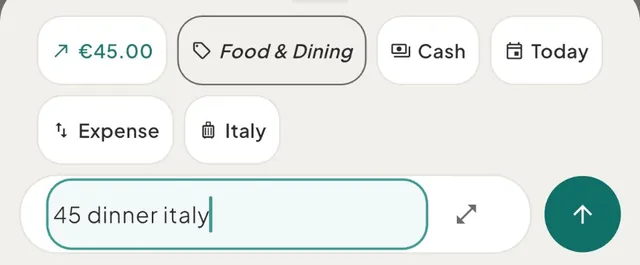
See put spending on a trip or a project.
What the bar does not read
- A split of one purchase across categories.
- Two entries in one line.
monoprix 23 and pharmacy 12shows "€23.00?" and hands the first amount to the form; add the second on its own line. - Days further ahead than the coming week: in
in 2 weeks 50 dinnerthe 2 is read as the amount. Use the form for those.
Worked examples
All examples assume a Current account and Cash in euros, Dollar savings in US dollars, euros as the main currency, the starter categories, an open trip named Lisbon, and today as Saturday 24 October.
| You type | Tavala reads |
|---|---|
coffee 4.80 | €4.80 expense, Food & Dining (guess), note coffee, today |
coffee 4,80 | the same: a decimal comma |
groceries 62.40 | €62.40, Groceries (matches your category name), note groceries |
1.299,50 sofa | €1,299.50, Housing (guess), note sofa |
1,299 sofa | €1,299.00: one separator before three digits is thousands |
2k bike | €2,000, Transport (guess), note bike |
lunch 12+8 | €20.00, Food & Dining, note lunch |
lunch 12 + 8 | €20.00, Food & Dining, note lunch |
40/3 dinner | €13.33 |
3x 4,20 beer | €12.60, note 3x beer |
2 coffees 7.60 | €7.60, note 2 coffees |
twelve fifty lunch yesterday | €12.50, Food & Dining, yesterday, note lunch |
taxi 1200 MKD | 1,200 Macedonian denar, Transport, note taxi |
$12 taxi | US dollars 12.00, Transport |
20 quid taxi | £20.00, Transport |
kr 50 bus | asks: "kr 50?", with DKK, NOK and SEK to choose from |
12 PEN | 12 Peruvian sol |
12 pen | €12.00, note pen |
+3200 salary | Income €3,200, Salary |
got paid 3200 | Income €3,200, Salary, note got paid |
40 refund dinner | Refund €40, Food & Dining, note refund dinner |
300 tax refund | Income €300, category Refund |
moved 200 to savings | asks: Transfer from Current account to Dollar savings, finished in the form |
20 coffee cash | €20.00 from Cash, Food & Dining, note coffee |
9 lunch yesterday | €9.00 dated yesterday, note lunch |
vorgestern 1.500 laptop | €1,500.00, Shopping, Thursday 22 October |
20 groceries monday | €20.00 dated Monday 19 October |
15 taxi 3 days ago | €15.00 dated Wednesday 21 October |
15 taxi tomorrow | asks: "Tomorrow?", finished in the form |
~45 lunch | €45.00 estimated, note lunch |
dinner about 45 | €45.00 estimated, note dinner |
45 about dinner | €45.00, not estimated, note about dinner |
about 120 since friday | €120.00 estimated, dated today, note since Fri |
45 dinner lisbon | €45.00, Food & Dining, trip Lisbon, note dinner lisbon |
coffee with anna | no amount, so it cannot be saved. The note is coffee with anna |
Good to know
- A guess is not a rule. The bar always lets you change a chip before you save. Anything it got wrong is also editable afterwards: see edit, delete or undo a transaction.
- Keyboard. Return saves when the line can be saved, on every platform.
- Offline and on the device. The bar works with no connection and reads the line on the device; nothing you type is sent anywhere to be read.
Was this helpful?
No opens an email to support with this page’s address. Nothing is recorded here.